

Menu
Building a Safe Foundation for AI in Healthcare
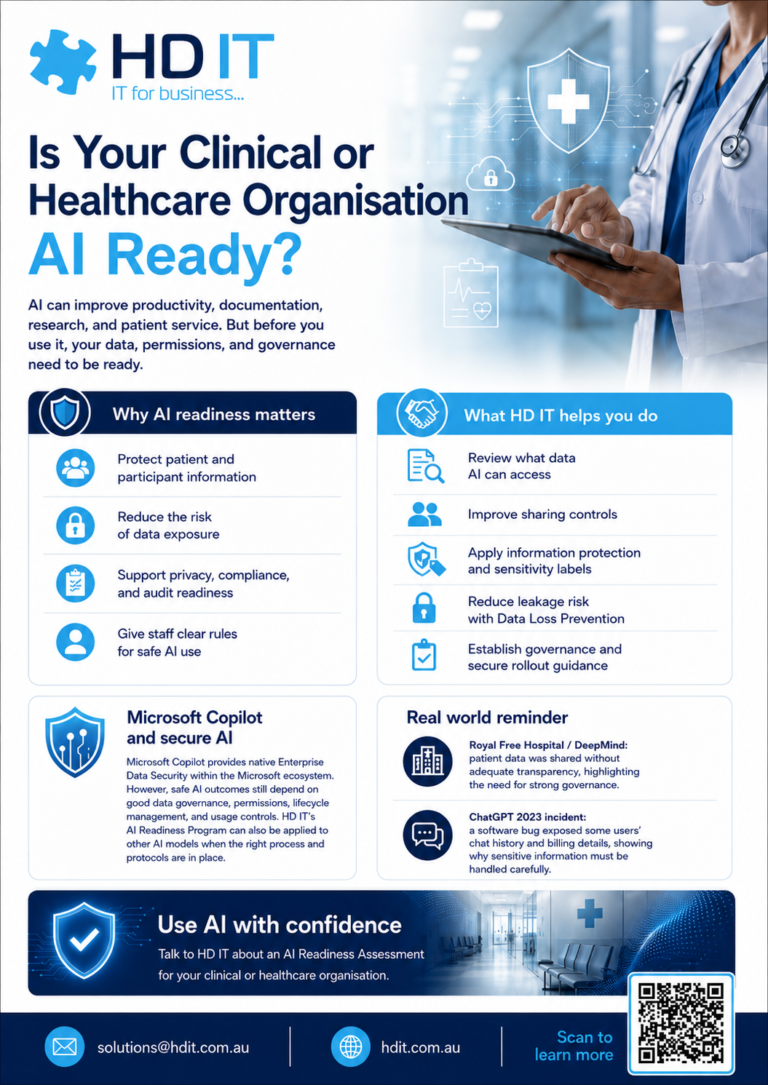
Building a Safe Foundation for AI in Healthcare
Artificial Intelligence is rapidly transforming the Australian healthcare and clinical sector, from diagnostic support to administrative automation. As digital health adoption accelerates, organisations are generating and relying on more data than ever before. However, deploying AI without a strong data foundation introduces significant risks. AI readiness is essential to ensure that systems are safe, accurate, and aligned with clinical standards before being placed in the hands of staff.
The Growing Importance of Data in Clinical Environments
Australia’s healthcare system is becoming increasingly digital, with electronic medical records, telehealth, and connected platforms now central to patient care. This shift is driving greater efficiency and improved outcomes, but it also means that AI systems are heavily dependent on the quality and structure of clinical data. Poorly structured or inconsistent data can result in unreliable outputs, which in a clinical context can have serious implications for patient care. Ensuring data is standardised, accurate, and governed is the first step to successful AI adoption.
The Reality of Data Risk in Australian Healthcare
Healthcare is consistently the most targeted sector for data breaches in Australia. The industry accounts for a significant proportion of all reported breaches, and a large percentage of healthcare organisations have experienced cyber incidents in recent years. Most breaches involve sensitive personal and health information, making them particularly damaging in terms of both privacy and reputational impact. Importantly, not all incidents are the result of sophisticated cyber attacks. Many are caused by human error, poor access controls, or misconfigured systems, highlighting gaps in governance rather than technology alone.
When AI and Data Governance Fall Short
The introduction of AI can amplify existing data risks if proper controls are not in place. There have been multiple real-world examples where poor governance has led to exposure of sensitive healthcare data. In some cases, staff have unknowingly uploaded patient information into public AI tools or personal cloud applications, creating unintended data leakage. In others, AI-powered systems such as chatbots or analytics platforms have shared or exposed patient data due to inadequate configuration or oversight.
More severe incidents have occurred where healthcare AI platforms have suffered large-scale data exposure due to misconfigured infrastructure, resulting in highly sensitive patient records, including mental health information, being accessible without proper protection. These examples demonstrate that AI does not create new risks in isolation but significantly increases the impact of existing weaknesses in data management and security.
Why AI Readiness Must Come First
AI readiness in healthcare goes beyond technology deployment. It requires a structured approach to data governance, including clear policies on data access, strong security controls, compliance with privacy regulations, and ongoing monitoring. It also involves preparing the workforce by defining how AI tools should be used safely and appropriately within clinical workflows.
Enabling Secure and Effective AI Adoption
When organisations invest in data quality, governance, and security upfront, they create a foundation that allows AI to deliver real value. Clinicians can trust the outputs, staff can adopt tools with confidence, and organisations can demonstrate compliance and accountability. In an industry built on trust and confidentiality, AI readiness is not optional. It is a critical enabler of safe, scalable, and effective innovation in healthcare.
Download your free AI Policy Template here: Get Your Free Critical AI Policy for Your Organisation – HD IT
Contact us to learn more about secure AI solutions that boost productivity: Contact – HD IT
Recent Posts

